In my previous post, I explained my belief in the Bible’s claim of a global flood that nearly eradicated humans from the face of the earth. The Bible reports that God preserved a remnant of eight people to repopulate the earth. Significantly, it also states that God gave the rainbow as an evidence that he would never again flood the earth as a form of judgment upon its inhabitants.
Skeptics scoff at this, explaining the rational process for the presence of rainbows. I don’t disagree with these explanations. However, I would suggest that the logical, scientific explanation for rainbows does nothing to discredit the faith belief in what that particular rainbow represented (and what all subsequent rainbows have the ability to remind us). The explanation of a rainbows existence and the rationale for why rainbows exist are at least partially exclusive. But I digress.
Despite the phenomenon of rainbows, we – almost predictably – experience flooding. Sometimes on a widespread scale. While the list of floods in the last fifty years is impressive, it’s interesting to note that there is no record of any second global flood. (Note: while many efforts have been made to discredit the account of the original flood, much historic, geological, and anthropological evidence supports the biblical claim.)
God never promised that there would never be another flood. He promised that he would never use flooding waters as an expression of global judgment. Some people want to suggest that God brings hurricanes, earthquakes and their subsequent floods as judgment upon a nation or its people for its pagan beliefs.
While, I’m not qualified to declare unconditionally and authoritatively that this is or is not an expression of God’s judgment, I personally don’t believe that natural disasters are are a picture of God’s wrath. If it is, the United States should be in a collective state of woe for the impending judgment awaiting it (as a self-identified nation “under God”). Rather, I go back to previous statements (made in prior posts) that we now live in a broken world with a significantly larger quantity of water cycling through its closed system. Consequently, catastrophic floods are a periodic and unfortunate phenomenon.
My hope, then, is to draw attention back to Jesus’ declaration that all people turn to God before the next storm hits. Whether it is literal or figurative, and whether you face it alone or with your community, I invite you to turn to God and call upon him for rescue.
In my previous post, I mentioned that I believe there were two events that radically altered the earth’s environment. The first event was the original rebellion of man against God. That rebellion changed the earth from its utopian origins to its dystopian present, replete with destructive storms.
This first event was the precursor to the second event. After the first event, humanity moved forward in its “new normal.” A family became a clan, the clans divided and claimed new territory. Populations grew and generations passed.
Every person and every generation existed in the “new normal.” Each person’s death recalled the original rebellion. As the population expanded and generations passed, the story was changed or forgotten. As time passed, people grew more distant from God.
The Bible reports that after ten generations, God determined to judge the world’s population for its rebellion (and the details of his judgment can fill an entirely different post). He chose a global flood of waters as his means of judgment.
Giving 100 years of warning, he set aside one lone family to escape the judgment. The patriarch of this family, Noah, began to build a boat (as God commanded) to withstand and endure the judgment. He did so in a world that possibly, had never seen rain fall from the sky. Who knows what people thought of Noah or even said to him over that 100 years of ark-building. That no other people were allowed to join him on the boat allows for the fair assumption that they likely reasoned that the world could never exist differently than how they had experienced it. Then the time arrived.
On the 17th day of the second month of Noah’s 600th year, waters fell from the sky an a way unprecedented in world history.
It would be inadequate to think only that it rained. Instead, imagine a drenching rain where you’ve sought refuge under a tarp, tent, or canopy. You see the canopy sag as it becomes water-logged. At first, a few beads of water soak through, dripping overhead. Then, suddenly, without warning, the canopy rips with a load tear and you are blanketed by a sheet of water that literally knocks you off your feet.
This is what the Bible says happened, except on a global scale. The Bible says that in the creation, God had blanketed the earth with a canopy of water. At this time of judgment, God released this canopy and its waters plummeted upon the earth. The volume of water overwhelming the earth is unimaginable, even in light of our modern-day comparative calamities.
Compounding the disaster, the Bible says that God caused the waters under the earth to spring forth. These were no bubbling brooks of natural springs. Its appropriate to think of violent earthquakes, oceanic volcanoes, and tumult that results in landscapes like Colorado’s Flatirons mountains. This was happening on a global scale. Oceans of waters from above. Geysers of waters from the ground.
Chaos.
With each new violent storm, we see a new library of videos of violent winds pushing walls of water, sweeping parking lots of cars into and then through buildings. Homes, offices, and stores instantly are deconstructed as the unrelenting force of the waves pushes against and ultimately over them. Stories are shared of a man being found on a roof six miles out in the ocean, or of a dolphin rescued one mile inland.
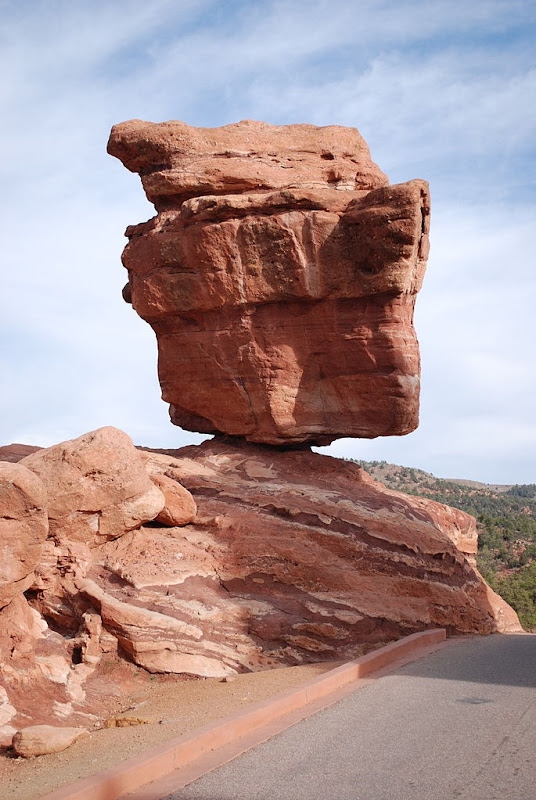
In light of this modern evidence, I have no problem reconciling why I will find an unbalanced boulder atop a mountain in the middle of the rockies, or sea life fossils in the middle of the continental land mass. In this, I see evidence of God using nature as a means of both judgment and new beginnings.
When disaster strikes, there are a few predictable negative responses, theologically speaking:
“If God is in control, he made this happen.”
“God (the cosmic clockmaker) isn’t in control, so he’s not worth worshipping.”
“This is evidence that there is no God.”
Among the many shortcomings of us humans is our tendency toward dichotomous thinking. Black/white. Either/or. We presume that only two options are correct, that it cannot be somewhere in between…or somewhere completely outside of the two. We tend to think that if God exists, everything should be good all the time. So if something bad happens, the foundational thoughts on God are flawed. The reality of bad *must* mean that God is not good, God is not God, or that God simply is not real.
Yet, God’s role in adversity this not hindered by the limits of human reasoning.
Presuming God exists, if he is also sovereign, this means he is in control. In this respect, God bears the responsibility for any (and every) event that humans would label “bad,” “tragic,” or “disastrous.” If we lived in an edenic/idyllic/perfect world, this would mean that God is exceedingly cruel and is not at all good.
We don’t live in a perfect world.
The fact is, we live in a chaotic world. It is characterized by an ever-increasing frequency of earthquakes, destructive winds, demolishing storms, eruptions, and devastating waters. Ours is a world that is obeying the laws of thermodynamics and moving rapidly toward a state of increasing physical disorder. It exists in a universe that is perpetually expanding toward disorganization, too. It’s a world that appears destined for destruction and is growing increasingly unstable and volatile.
If we can agree that the world is becoming increasing disorganized and unstable, it’s appropriate to ask why this is so. There is no shortage of conjecture about human complicity in the not-small matter of global destruction, but I retrospect for the sake of maintaining focus on the question of God’s role
Two significant events changed the world from its original conditions to the ones within which we currently exist. Both are relevant to the current conversation; this writing addresses the first event’s role in explaining contemporary calamities.
The first event that changed the global environment is humanity’s original rebellion against God. Originally…according to the Bible…was created good, even perfect. God and humans enjoyed a close relationship. Yet, that relationship was destroyed when the first humans were deceived by evil, distrusted God and rebelled against him. The consequence of that rebellion was the eventual death of every person and, among other things, a curse upon the earth. This rebellion tainted the environment, altering the world from its utopian origin into a dystopian state, with ramifications and implications into the natural order that followed and is, even today.
Jesus reflected this reality in his teachings. He acknowledged we live in a world governed by natural laws. He didn’t blame God. In Luke 13, he spoke of a tower in Siloam fell, killing 18 people. We don’t know if it was a natural disaster or a man-made mistake. We we do know that Jesus went out of the way to say that the people weren’t victims expressly because they were in rebellion to God. He refuted the “cruel God” argument. In the very next breath, though, Jesus said, “but unless you turn to God, you too will die!” In this, he undergirds the reality of God, not entertaining a notion that God is not real.
His point is that everybody dies in a broken world and the only hope for anyone is found through faith in God. Whether it’s by being crushed under a tower, swept away in a storm, or asleep in bed after a long, quiet life, death comes to every person….and every death is tragic. Furthermore, Jesus defuses the “uncaring God” argument with his declaration that turning to God is the sole means to escape the tragedy of death, and that it is available to every person, without exception.
The effort to reconcile God’s role in disaster is actually more about man than it is about God. The only way a person can lob accusations against God, suggesting that he is cruel or lazy, is if that person assumes that he sits in an authorized position of judgment. While this doesn’t mean that humans have no right to exercise genuine inquiry to ask “why?”, those who are asking should have a proper understanding about themselves before they can ever hope to have a right understanding about God. If people are intrinsically good and in right standing with God (or even in judgment over God), this explains the speculation and conjecture about tragic calamities and the implications thereof.
However, if (as Jesus taught and the Bible reports) that people exist in an intrinsic position of rebellion against and defiance to God, the question changes. Instead of asking, “Why?” the more reasonable question is “Why not?” If humans are, by their nature, in a state of opposition to God, and live on a realm barreling toward its total destruction, why wouldn’t there be regular, periodic, and increasingly numerous of escalating upheavals? Indeed, if humans live in a judged state of rebellion on a judged world of destruction, it makes sense that humans should expect to endure natural disasters on an increasing frequency. Accordingly, a lack of forewarning and the potential for each to claim any unpredictable number of lives is likewise reasonable.
Because of the utter impossibility to prevent or avoid these natural disasters, the best (only) hope is to properly view the bigger picture with the perspective offered by the one person who authoritatively spoke with the divine insight. This is why Jesus said, “repent now!” when talking about the Siloam tower. He acknowledged that disasters will happen in a fallen world destined for judgment. Even so, death before reconciling with God is the biggest disaster.
I am not afraid of storms, for I am learning how to sail my ship.